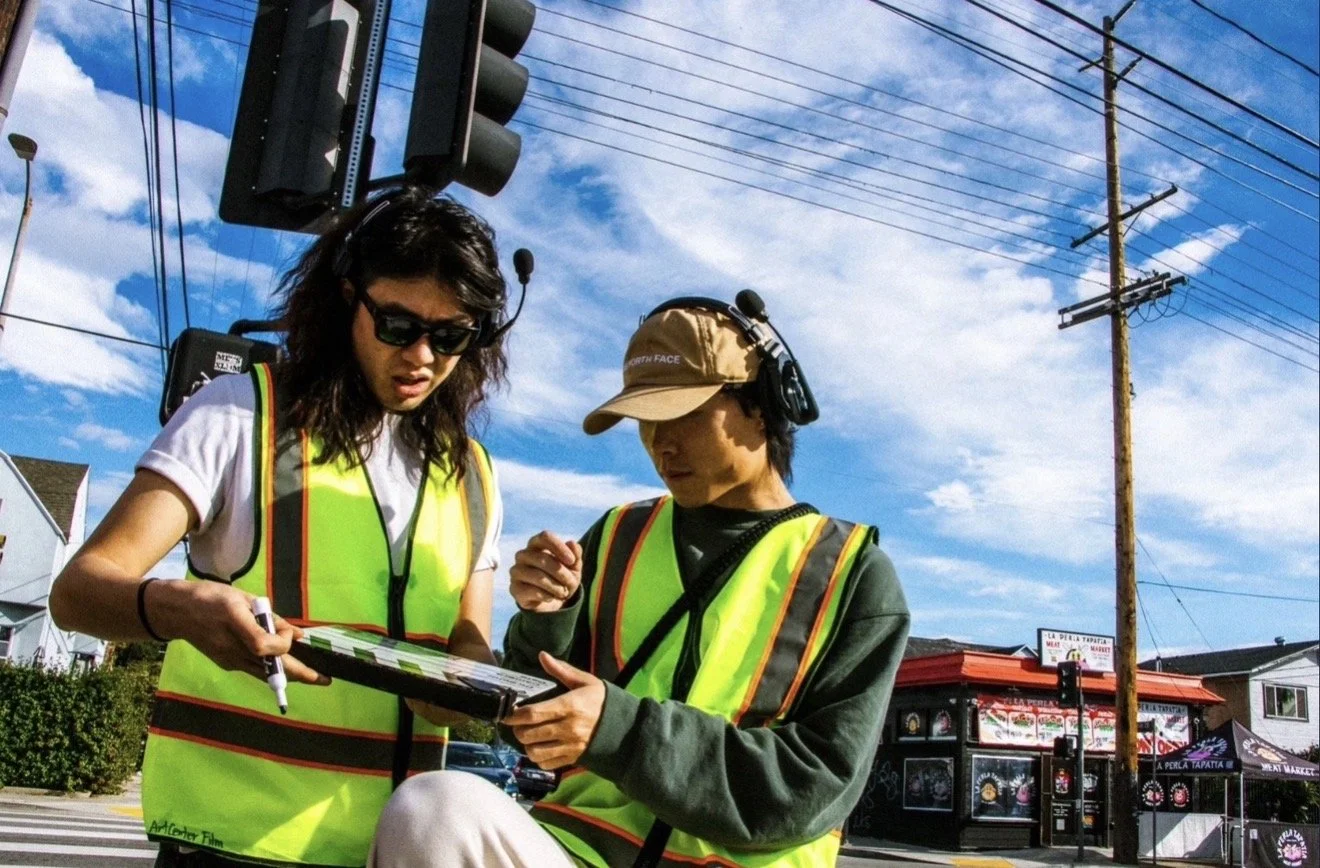
* As a part of our campaign to raise awareness about child exploitation, interviews with the cast and crew of ‘All Hail The King’ will be released until the campaign ends 11.12.2027 *
A production designer is responsible for creating and shaping the physical world audiences see in a film.
Working closely with the director and cinematographer, they develop the visual identity of locations, sets, props, furniture, textures, and other environmental details that help establish a story’s setting, characters, and time period.
On a film set, the production designer oversees the art department and develops the overall visual concept before other members of the team help bring it to life. Their work can be essential to making an audience believe that a contemporary location belongs to another decade or another part of the world.
Syd Shen is a filmmaker, writer, and production designer whose work spans directing, assistant directing, and art department roles. His experiences working across different departments led him toward a growing interest in creating cinematic worlds.
For All Hail the King, Shen worked alongside production designer Jane Hamor to create environments that move across different periods while grounding the film’s fictional and semidocumentary elements in a believable reality.
Syd Shen: It happened pretty naturally. I originally came to ArtCenter because I wanted to direct. Before that, I was actually a professional writer. But when you’re in film school, you end up doing a lot of different jobs besides directing.
During my first year, I was doing basically whatever I could find. Writing, working on sets, being a first AD, all kinds of things. Eventually I started becoming interested in other parts of filmmaking, and production design became one of the biggest ones.
I’m also really interested in history, so once I started working on projects that involved recreating different periods, I thought, “Why can’t I do this?” It became something I really enjoyed, and eventually it became another profession for me.
Interviewer: Was Rosemead Motel your first job?
Syd Shen: Yeah, that was my first. The director and I talked about films and visual ideas a lot. She wanted to create something that felt like China during a particular period, but we were shooting it in the United States. So part of my job was figuring out how to recreate that Chinese environment and time period inside an American location.
Looking back at that film now, there are definitely things I would change. Things I would approach differently. But I think our understanding of the motel location and the way we transformed it worked pretty well.
Interviewer: Did working in other departments change you as a filmmaker?
Syd Shen: No matter whether you’re a production designer or a first AD, just being on set gives you a lot of experience.
Making a film isn’t only about writing a story or having theories about filmmaking. There’s a practical side to it. You have to work with people. You have to deal with real situations and understand how a set actually functions.
As a first AD, you’re moving around the entire set. You’re interacting with everybody, and you start understanding exactly what every department is doing. That’s really helpful when you eventually direct.
The same thing applies to production design. You’re constantly thinking visually. So when you’re directing your own project, you’re able to think like a production designer too. You understand another way of looking at the film.
All of those experiences help you as a director. All of these jobs are about creating the world that people see in the film.
Obviously the cinematographer is a huge part of what the audience ultimately sees too, but as a production designer, you’re creating the physical world that’s being photographed.
For me, production design is about world-building.
A lot of the time on independent films, you’re just working with what you have.
That’s actually a really valuable experience because you’re not always going to have a huge budget where you can build whatever you want from scratch.
Sometimes you walk into a practical location and ask, “What do we already have here? How can we make this come alive?”
Instead of building something completely new, the challenge might be figuring out how to transform a real location and make it feel like the 1980s, the 1990s, or the early 2000s.
You have to learn how to use what’s already there. Working these different positions definitely reinforces that.
Interviewer: How do you make a contemporary location feel like it belongs to the early 2000s?
Syd Shen: First, you remove the things that obviously belong to a later period.
For example, with an office location, you might start by taking away everything that feels like it came from after 2010.
Then I start thinking about the character. What would this person actually have in their office? What kind of phone would they use? What kind of pens or notebooks would they have? What computer would they own?
You build outward from the character.
The character has to feel alive through the environment. If you can’t understand anything about the character from the space they’re living or working in, the location can start to feel empty.
Of course, you also work with the director and the cinematographer to discuss the kinds of colors they want to avoid. Working within a limited palette and creating depth in the frame using different objects. Things like that.
The screenplay is extremely important too. You really have to dive into the script and ask what kind of character this is and how you can express that character visually through the environment.
On some projects, the director becomes the main bridge between production design and cinematography. Ultimately everybody is working toward the same image, but the director is guiding that overall vision.
Interviewer: What does your role look like once you’re actually on set? Are you personally placing every prop into the frame?
Syd Shen: Usually I’m not personally putting every single thing into the frame.
You have other people working with you. You might tell somebody, “This goes here, that goes there,” while you’re looking at the overall frame and making sure everything is working visually.
The production designer creates the visual concept. Then you also have art directors, set dressers, art PAs, and other members of the department helping bring that concept to life.
As the production designer, you need to understand and execute the vision of the end result. It needs to exist in your head, in your references, or on your laptop. Then the people working with you help turn that vision into something real.
In that way, it’s similar to directing. The director needs to have a vision for the entire movie. The production designer needs to have a vision for the physical world of the movie in a way that aligns with the directors and producers’ vision.
Interviewer: What kind of work have you been doing lately?
Syd Shen: I’ve worked on several vertical series, mostly doing art department and production design work.
I’ve also been developing my own short films. That’s ultimately what I want to do. I still consider myself a director and filmmaker first, so I’m trying to keep making my own work while working professionally on other productions.
Interviewer: Are vertical productions different from the student films you worked on in film school?
Syd Shen: They’re very different.
On student films, you gather a group of filmmakers and everybody has their own role, but there’s usually this feeling that everybody is there because they care about making the film. There’s a creative energy around it.
With the vertical productions I’ve worked on, everything is much more about execution. A lot of the decisions have already been made. You’re basically there to do the job.
Sometimes when you’re working on an independent short film, even if there’s no money, you can see that the project has potential. You think, “Maybe this could actually go somewhere.” So you put a lot of effort into it and contribute creatively.
With some vertical productions, you don’t necessarily have that same feeling. It’s much more industrial. At least it can feel that way.
I think vertical filmmaking has potential. The problem is that a lot of the productions being made right now aren’t really exploring that potential.
The frame is different, so theoretically filmmakers can create a visual language specifically for that format. There are already examples of it being done well.
You can also just turn your phone around and it’s widescreen. Some people frame for both. There’s a lot more of vertical filmmaking going nowadays compared to the past.
Interviewer: What advice would you give somebody who wants to become a production designer?
Syd Shen: Practice observation. You have to observe the world and reality constantly. Pay attention to everything around you.
Look at how people live. Look at their rooms, their objects, their furniture, their clothes, the places they work. Take everything in.
Eventually, those observations become part of the worlds you create in your films.
Interviewer: Were there particular movies that made you want to become a filmmaker?
Syd Shen: There were so many, but if I had to choose three, I would probably say Trainspotting, Paris, Texas, and Fitzcarraldo.
Trainspotting, visually, I’ve taken a lot of inspiration from that film, especially in terms of production design.
But I also think it depicts addiction incredibly well. To me, it’s one of the best films about addiction.
It’s a film where the visual world and the subject matter are both extremely powerful.
Paris, Texas, on the other hand, to me represented a new way of storytelling. Remember, before I came to ArtCenter I was primarily a writer. With Paris, Texas, you have something that can feel like a very simple or classical story, but the screenplay is extraordinary.
That combination really surprised me. You can take something that sounds simple as a story and elevate it through the quality of the writing and filmmaking. That was mind-blowing to me.
And Werner Herzog’s Fitzcarraldo? That movie is crazy.
It’s about this European man in South America who dreams of building an opera house in the Amazon. He buys this enormous steamship and tries to move it across a mountain through the jungle.
But what’s incredible to me is the filmmaking behind it. Herzog and the crew actually moved a huge ship through the Amazon while making the movie.
When you know what they physically went through to create those images, the filmmaking itself becomes part of what makes the movie fascinating.
Interviewer: You grew up in China, right? How did your relationship with filmmaking start?
Syd Shen: I watched a huge number of movies growing up. More than usual, let’s say.
I started watching films when I was probably five or six years old. By the time I was around eighteen, I had already seen an enormous amount of cinema.
Eventually I thought, “I’ve watched so many films. Why don’t I try writing one?” So I did. People seemed to like it.
Then somebody actually paid me to write a film. I thought, “Hell yeah. Maybe I could do this professionally one day”.
That’s really how I got into filmmaking. It was very organic.
Interviewer: Had you been writing creatively before you started writing films?
Syd Shen: When I was really young, maybe seven or eight years old in elementary school, I actually won a few awards for writing.
But after elementary school, I basically stopped writing completely. For years. Until I started writing screenplays.
Interviewer: What are your goals for the future?
Syd Shen: I want to make films. There are all these different roles that I’ve enjoyed doing. I enjoy contributing to making movies in different ways.
Even though writing and directing my own films is what I’m working toward, everything else I’ve done has helped me understand filmmaking from another perspective.
You can follow him on instagram here.
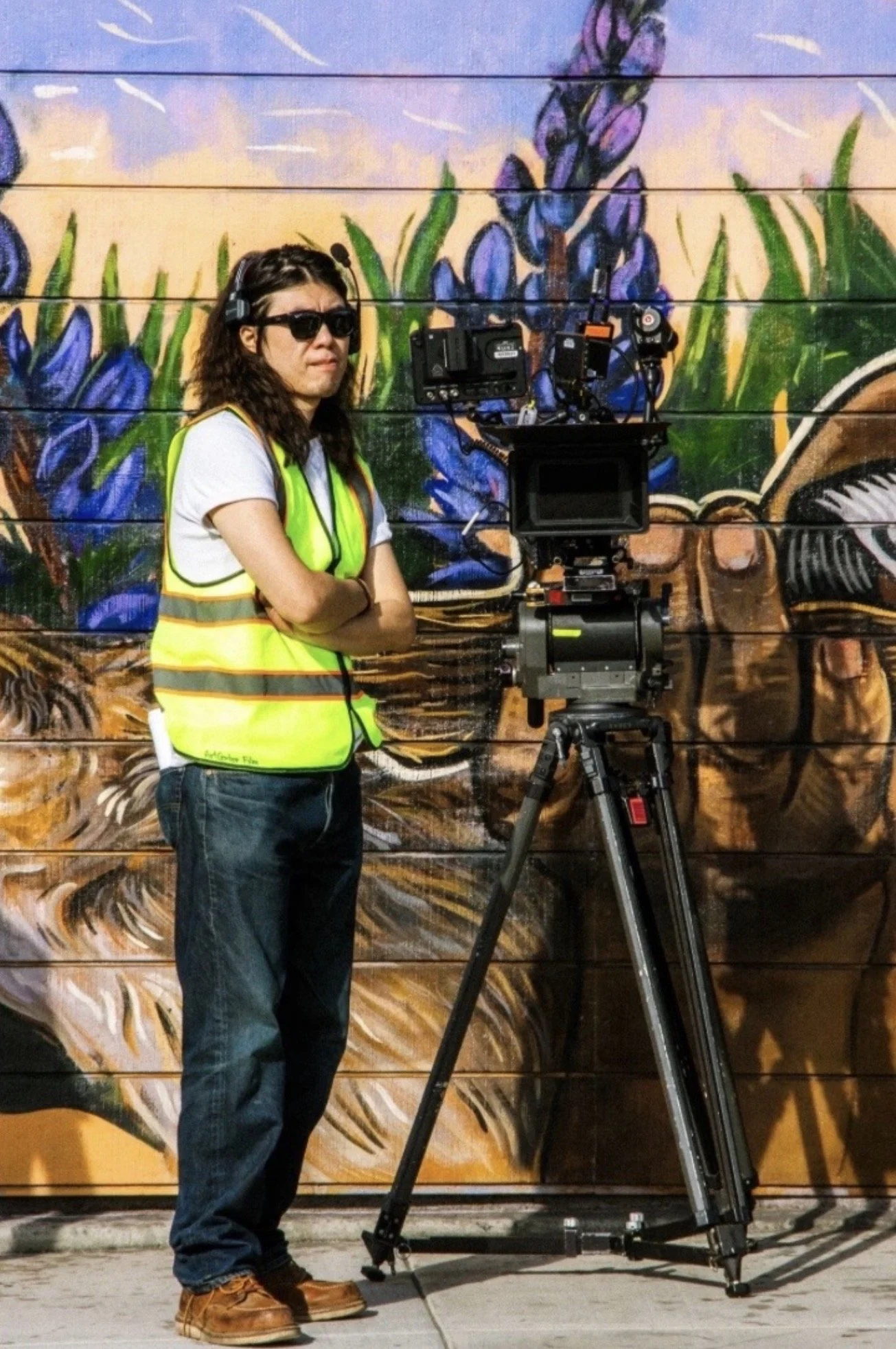
Syd Shen on set.
