RAHUL UPPALURI, GAFFER
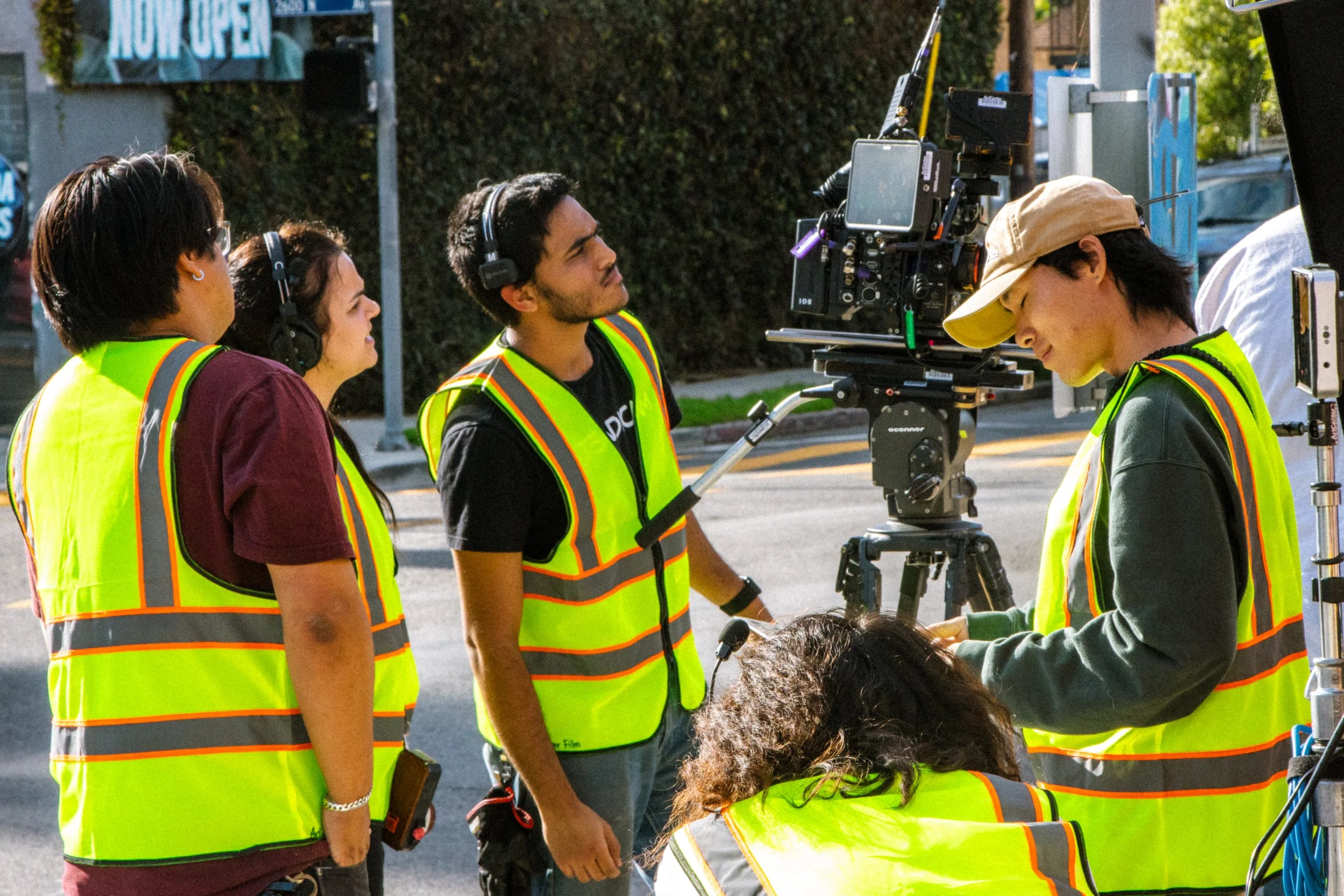
* As a part of our campaign to raise awareness about child exploitation, interviews with the cast and crew of ‘All Hail The King’ will be released until the campaign ends 11.12.2027 *
A gaffer, also known as the chief lighting technician, is the person who leads the electrical and lighting department on a film set.
They work closely with the cinematographer to translate the desired look and mood into practical lighting setups. The gaffer oversees the crew, equipment, and technical decisions needed to execute that lighting safely and effectively.
Rahul Uppaluri is a cinematographer, gaffer, and editor whose work spans both the camera and electrical departments. He studied at ArtCenter College of Design, graduating in 2026, where he developed his approach to visual storytelling through lighting, composition, and cinematography.
INTERVIEWER: How do you describe the job to people who don’t know what you do?
RAHUL UPPALURI: Traditionally, the cinematographer, or director of photography, works with the gaffer and explains to them the kind of lighting they want. All the decisions that come with achieving that lighting are partly the responsibility of the gaffer, or Chief Lighting Technician.
INTERVIEWER: How did you end up finding yourself in this position?
RAHUL UPPALURI: I work mostly as a cinematographer, and I enjoy working with lights, shadows, and images. I also really enjoy translating abstract emotions and feelings into something more concrete, which is light and shadow. So working as a gaffer on sets is a natural extension of that. It allows me to focus on one aspect, which is lighting, and really hone my craft in that.
Being a gaffer also allows me to peer into the process of my peers and fellow cinematographers. I only work with cinematographers who I admire, and gaffing for them is a way for me to explore my own craft and also find out what my peers are doing.
INTERVIEWER: You grew up in India, right?
RAHUL UPPALURI: I did.
INTERVIEWER: What was the perception of being a film student there?
RAHUL UPPALURI: In India, the role of a cinematographer is not as well known or celebrated. Indian films would be marketed on the status of the star, the music, and the melodrama, which is not necessarily a bad thing. It’s slowly changing, and there are a few exceptions. There are a few famous cinematographers, or “cameramen,” as they’re sometimes colloquially referred to.
But obviously, I was met with a lot of resistance when I approached my parents and told them that I wanted to go to film school. Being Asian parents and all, they wanted me to pursue a safe career, like being a doctor, engineer, or lawyer. My father was convinced that I wanted to go to film school because I wanted to skip out on working hard and studying.
What convinced him was that I did well in high school, and I got a letter of recommendation from the principal of my school at the time. That also landed me an internship at a local TV station.
I’d also been a child actor, so I had a few contacts from my time doing that. Eventually, I was able to convince my parents to let me go to film school.
INTERVIEWER: Was there a specific film that made you pay attention to cinematography?
RAHUL UPPALURI: I would have to say The Coen Brothers’ No Country for Old Men. Watching that for the first time, it was simple, yet so beautiful, and it never takes you out of it.
I don’t think I can think of one single shot that stands out in that film. It really is a comprehensive piece. I was very taken by it.
INTERVIEWER: No Country for Old Men was shot on 35mm film by cinematographer Roger Deakins. Have you had a chance to shoot with celluloid?
RAHUL UPPALURI: In my own practice, I shoot a lot of still film, and I’ve also worked in a photography developing lab. I’ve shot a project on 16mm film, and I’ve served as a gaffer for numerous projects that were shot on celluloid. So celluloid has been a great love affair.
INTERVIEWER: How would you say practicing still photography impacts your work as a gaffer and cinematographer?
RAHUL UPPALURI: Still photography offers a more accessible route to engage with all things cinematography and lighting.
Essentially, being a cinematographer is not too dissimilar to being a photographer, because you’re essentially taking 24 still pictures per second, and when they’re played in motion, it creates the illusion of motion.
Practicing still photography lets you zero in on the still frame. That is very freeing in a lot of ways because you don’t have to deal with motion, but it also comes with its own challenges because you only have that one frame to express whatever you want to express.
INTERVIEWER: How do you land gigs as a gaffer on sets here in L.A.?
RAHUL UPPALURI: I’d say I’ve been lucky to work with many talented individuals who are working often. I’ve tried some job boards like Mandy and Nova, and while they might be good, the most fulfilling jobs I’ve gotten have been through word of mouth.
INTERVIEWER: I assume that working as a gaffer, there are times where there’s conflict between the gaffer with the cinematographer and the director. What’s that dynamic like?
RAHUL UPPALURI: Obviously, we’re all different people, and we might have different solutions to the same problem. As artists, all of our tastes differ. I have my own taste, and the cinematographer I’m working with might not share my taste in a particular scenario.
I always approach creative conflicts like these with humility and acknowledge the fact that it’s a difference in taste, and there’s no right and wrong in art. It’s subjective a lot of the time.
When I’m working as a gaffer, especially, I always give precedence and priority to the cinematographer’s wishes. And when I’m a cinematographer, I give priority to the director’s wishes.
When there’s a disagreement, I’ll respectfully let them know my opinion in a way that’s not conflicting, but rather coming from the point of view of collaboration.
A lot of the time, I find that when we have a conflict and approach it as a discussion rather than a fight, we reach a middle point that takes us to a place that neither of us originally envisioned. I usually end up liking that more than my original opinion that caused the conflict in the first place.
INTERVIEWER: When you got to film school, did you already know you wanted to be a cinematographer?
RAHUL UPPALURI: When I got to film school, I was torn between wanting to be a cinematographer or an editor. I really enjoyed both of those things.
I definitely knew I didn’t want to be a director. I didn’t particularly enjoy the process of directing actors. That’s not to take anything away from the craft, and I have immense respect for actors.
I believe that it’s the hardest job on set because they’re the most vulnerable and have the most to lose. They’re the ones who have their likeness on the line.
I really enjoyed the process of images, and I couldn’t separate myself from the frame. At the beginning of film school, obviously, you have to direct your own films and work as a director. Even when I was working as a director, I found myself really enjoying all the things that came with the frame: lighting, composition, camera movement.
When I was working with a cinematographer, I felt limited because I only ever wanted to do the job of the cinematographer. So I decided to make the jump.
INTERVIEWER: What do you think is the most challenging part of being a gaffer?
RAHUL UPPALURI: I’d say it’s working harmoniously with the vision of the director and cinematographer, and communicating that vision effectively to the electricians and grips who are actually achieving it.
Also, working under time constraints is a big challenge because lighting usually takes time. A lot of the time, especially with newer and less experienced filmmakers, they fail to account for the amount of time it takes to light something.
So figuring out ways to be more efficient and reduce the amount of setups is important. I’d say time, really, more than communication, is probably the most challenging part of being a gaffer.
INTERVIEWER: How does your preparation process differ when you’re working as a cinematographer versus as a gaffer?
RAHUL UPPALURI: Being a cinematographer, obviously, you have all the preproduction that comes with it. You’re working with the director to create shot lists, working with the assistant director to schedule and make your days, and then working with the gaffer and your camera team to prepare the equipment lists.
Working as a gaffer is more limited. I’m mostly thinking about the lighting package and the grip package, and working with the director of photography and sometimes production to get the lights and gear that we need to make our day.
INTERVIEWER: What’s most of the work you’ve been doing these days like?
RAHUL UPPALURI: Most of it has beem independent commercial work or independent short narrative pieces. I’m not really working on a lot of student films, unless it’s my friends and I’m helping my friends out.
I also do lighting for photo shoots, so there’s been a bunch of those gigs.
INTERVIEWER: How did you get involved with All Hail The King?
RAHUL UPPALURI: Through the director of photography, Wayne. He had been a good friend of mine, and he contacted me offering this project. We went to film school together.
I’d actually never worked with him in the capacity of a gaffer. Wayne had actually gaffed something that I had shot. But I’d always admired his work, and wanted to work with him. So I jumped at the opportunity.
I believe the first day was in an office building. I was there for every major shooting day and I had the same position throughout, to the end. Even in the later shooting dates.
INTERVIEWER: What memories from this shoot do you think you’ll carry with you in the future?
RAHUL UPPALURI: The people I got to work with. I met one of my best friends James McEntee (a Los Angeles-based cinematographer who worked in multiple positions on our production) on this shoot.
INTERVIEWER: What films have you seen recently that you feel have spoken to you?
RAHUL UPPALURI: The Invite, with Olivia Wilde, Edward Norton, Penélope Cruz, and Seth Rogen. I thought that was really well executed.
Also, the horror hits Obsession and Backrooms. It’s great to see what young filmmakers can achieve. I have a lot of friends who worked on Obsession and it’s also inspiring to see an independent production from Los Angeles, made on a budget of $750,000, get distribution, premiere, and make bank. Seeing it with an audience really gave me hope for the future of cinema.
INTERVIEWER: Do you think being a child actor impacted your relationship with cinematography?
RAHUL UPPALURI: Watching the inner workings of a set and being an actor is also why I have immense respect for actors and why I found it difficult to direct them.
I think it’s a really, really hard job to be that vulnerable and play these different characters, because you have to put yourself in really emotionally taxing situations.
I was in commercials, and I’d done a TV show. I played the lead’s younger self. I was in five episodes out of ten. I kind of fell into it. My mother was an executive producer, and I was hanging out in her office. The director had seen me and asked me to read for a part, and he really liked me. That’s how it started.
After that, I’d done some commercials, and then COVID hit, so there was a big pause in my gigs. I found that that life wasn’t for me, and I discovered photography. I discovered that that was something I enjoyed way more.
Even when I was on set as a child actor, I’d find myself talking to the cinematographer during lunch and having these conversations.
Also, from my time as an actor, I approach every script, whether I’m gaffing it or being a cinematographer, from kind of the lens of an actor, where the light, shadow, and camera are characters in the film.
I’m always trying to explore how the emotions and drama of the scene or the film can influence my work, in whatever position I’m in.
INTERVIEWER: Where can people find your work?
RAHUL UPPALURI: You can go to my website, follow me on Instagram, and hopefully people can see this film soon. It’s crazy.
INTERVIEWER: If you had one piece of advice to give to your younger self, who wanted to start filmmaking what would it be?
RAHUL UPPALURI: Talk to your peers. Talk to people.
When you’re starting out, especially, it’s easy to see your peers as competition. Earlier in my career, I would hesitate to reach out to them, even knowing that they might have skills that I could learn from.
Breaking through that perceived hierarchy has made me become a better artist and collaborator.
Follow Rahul on Instagram: @uppalurirahul and check out his website.
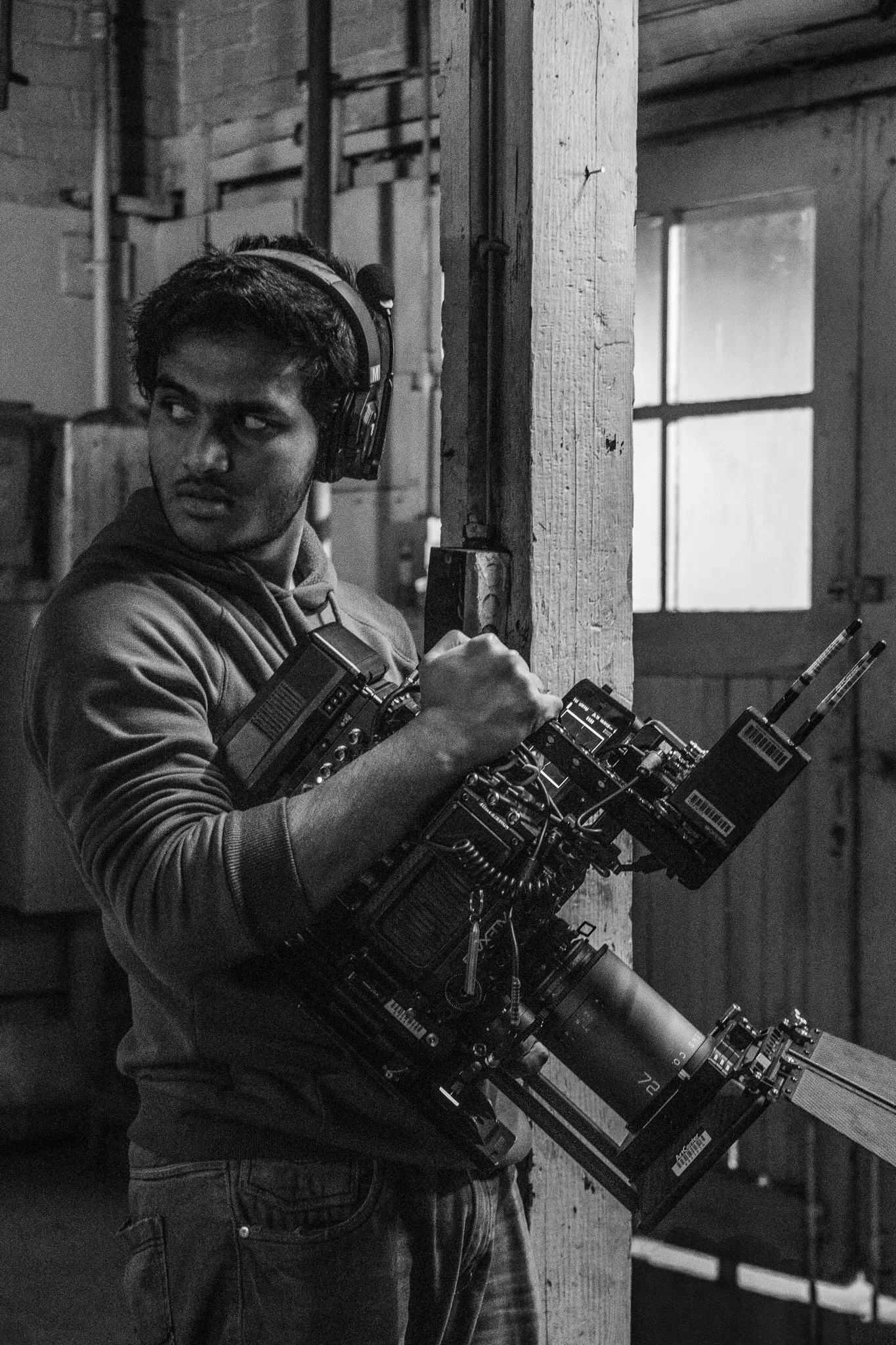
Rahul Uppaluri on set.
