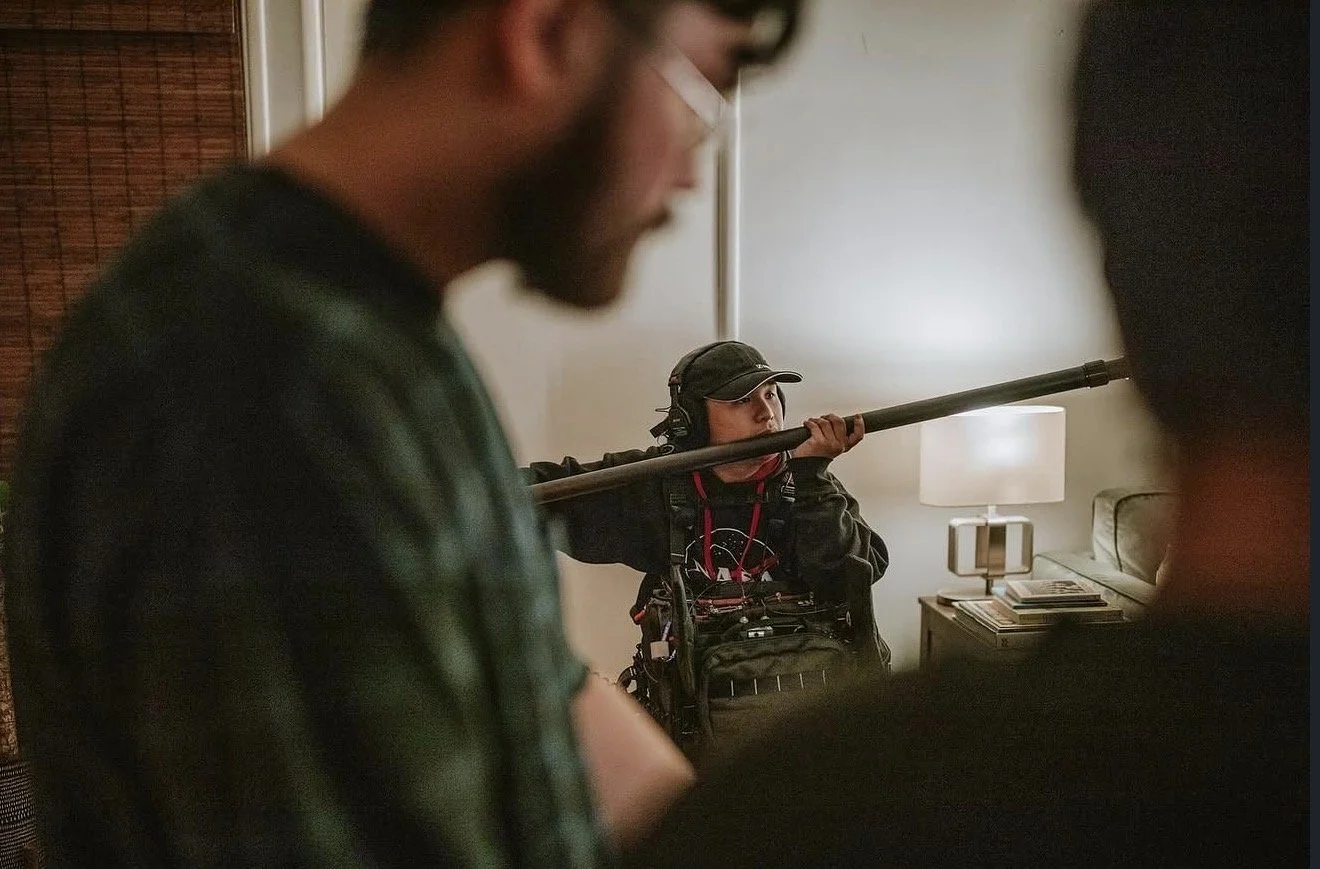
* As a part of our campaign to raise awareness about child exploitation, interviews with the cast and crew of ‘All Hail The King’ will be released until the campaign ends 11.12.2027 *
A production sound mixer is the person responsible for recording clean, usable audio on set during filming. They capture dialogue using boom microphones, lavaliers, wireless systems, and a field mixer or recorder while monitoring levels, background noise, interference, and microphone placement.
They usually lead the sound department, working with the boom operator and sound utility technician, and coordinate with the director, camera team, wardrobe, and post-production sound team. Their goal is to deliver dialogue and location sound that requires as little repair or replacement as possible later.
Ivan Bernal is a Los Angeles-based production sound professional working as a sound mixer, boom operator, and utility sound technician. He approaches production sound with an understanding of performance, atmosphere, and storytelling. His work focuses on capturing clear, natural location audio while collaborating closely with directors, actors, and the wider production team.
Interviewer: How did you get your start as a production sound mixer?
Ivan Bernal: I went to the New York Film Academy. I attended the campus in Burbank. I got into sound because, when we were students, we had to crew up together and make our own assignments. Nobody really wanted to do sound, so I picked it up and thought, "Hey, this actually seems kind of fun and interesting."
It worked out nicely because everyone else wanted to do something different, and I was one of the few people who genuinely liked doing sound. So people just kept calling me back. There was a general feeling that I had found the right role. I felt like I fit well within the whole crew process. I knew what I could offer and how I could contribute toward making a collaboration come together.
Interviewer: Did most of your training came from film school or from working on set?
Ivan Bernal: I'd say it's about fifty-fifty. The early work in film school definitely helped open the door and get me started. But the other fifty percent came from putting in the work outside of class: researching, reading guides, studying on my own, then applying that knowledge on set. A lot of it is just experimenting. You see what works in one environment, and if it doesn't work, you figure out a better approach for the next one. Technically, my degree was in directing. But I found directing to be pretty stressful.
Interviewer: What are the biggest mistakes you see student filmmakers make when it comes to sound?
Ivan Bernal: One thing they could definitely improve is microphone placement. It's something you're constantly learning because every costume is different and every situation is different. Sometimes you can mic someone up easily, and sometimes you can't.
The other thing is realizing that sound is fifty percent of the movie. Audiences can forgive visuals a little bit, but bad sound immediately pulls people out of the experience. It can completely ruin the immersion. When sound is done well, it's almost invisible. Producers and especially film students sometimes take the recording process for granted.
Interviewer: Would you say there were any moments on All Hail the King that really stood out to you?
Ivan Bernal: It was packed. We were trying to do a lot. Every production is different. Some sets are more relaxed and casual, while others are much more structured. A tighter schedule naturally creates a different environment.
One of my favorite memories was shooting the main interview scene in that really nice house we rented. Recreating them and getting to play around with that story was a lot of fun.
Interviewer: If you could give one piece of advice to your younger self starting out, what would it be?
Ivan Bernal: I'd tell myself to think smarter about what gear to buy and what gear to sell. It's better to invest in reliable equipment right away because you know you can trust it. And if you ever need to move on from it, quality gear also holds its value better. Good equipment isn't everything, but in sound it really helps us do our jobs more efficiently. There are already so many variables to worry about. You don't want your gear to become another one.
Interviewer: From your experience working on so many productions, how do you approach professionalism on set?
Ivan Bernal: Overall, I think it's about maintaining a positive attitude and knowing when it's time to be serious and when it's okay to relax more.
More importantly, it's about being present. You're constantly listening, not just to the sound you're recording, but to what's happening on set. What do people need? How does it sound? Can we skip something? Can we solve this another way? Being aware of the environment.
Interviewer: Do you mostly work on narrative projects, or do you do more commercial work?
Ivan Bernal: I think I mostly end up doing narrative work. That's just where I seem to get booked the most.
I've done smaller commercials and promotional projects too, but narrative has really become my bread and butter. I'm not against either one. At the end of the day, it's all work that helps pay the bills and lets me continue doing what I love. One of the things that originally inspired me was actually the blooper reel at the end of Rush Hour. Everyone looked like they were genuinely having fun making the movie. That's the kind of set I always want to be part of.
Interviewer: Is sound your full-time career, or do you balance it with other work? What's the reality of freelancing as a production sound mixer in Los Angeles?
Ivan Bernal: Production sound is definitely my primary occupation. Most of my work is production sound mixing, although I can also boom operate or work as a utility technician, even though I haven't done as much of that lately.
I'd like to explore more post-production sound eventually, but honestly, I have more fun being on set. It gets me out of the house, lets me meet interesting people, gives me unique experiences, and lets me help tell stories.
As for the market, because production sound is a fairly specialized field, we're actually a pretty close community. We help each other out. We have meetups. We pass work to one another. There's a real sense of collaboration.
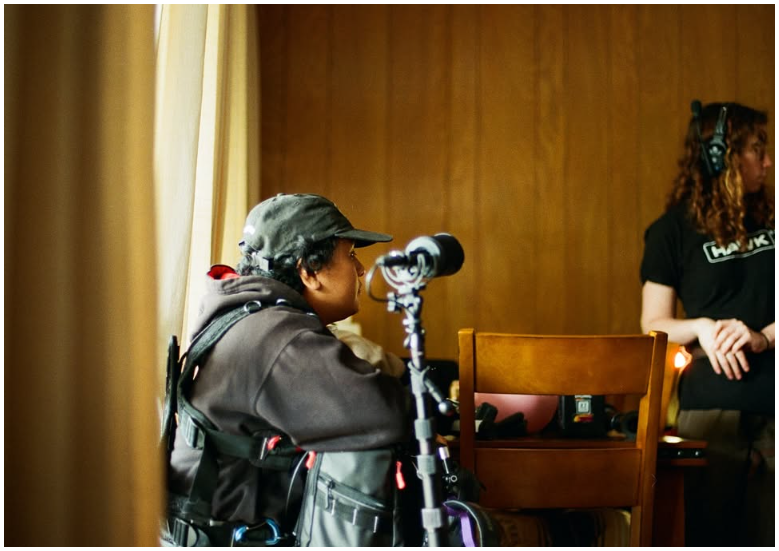
IVAN BERNAL on set.
